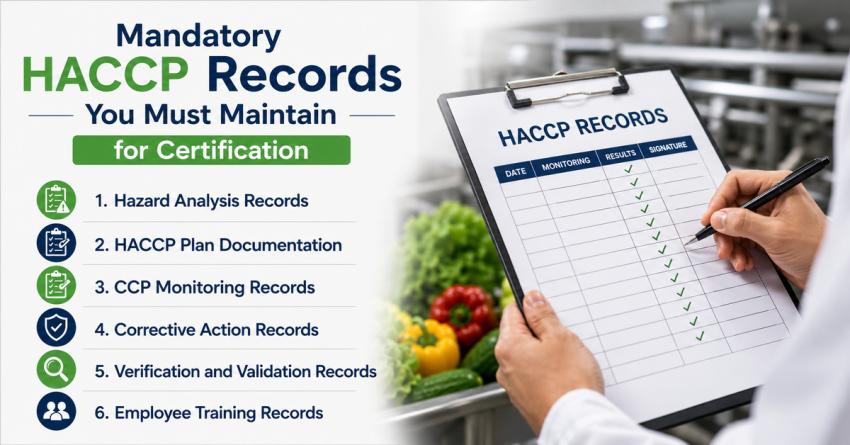
Maintaining mandatory HACCP records is essential for food businesses seeking HACCP certification and ensuring food safety compliance. HACCP documentation provides evidence that hazard analysis, critical control points (CCPs), monitoring procedures, and corrective actions are properly implemented.
HACCP is a systematic approach to food safety that identifies and controls hazards throughout the production process. Accurate record keeping is a mandatory requirement for certification, as it supports regulatory compliance, audit readiness, and effective control of food safety risks.
What Are HACCP Records?
HACCP records are documented proof of activities performed under a food safety management system. These records support the seven HACCP principles, especially documentation and record-keeping procedures.
HACCP documentation typically includes hazard analysis details, CCP monitoring logs, corrective action records, and verification activities. These records help demonstrate compliance with food safety standards and provide transparency during audits.
Mandatory HACCP Records Required for Certification
1. Hazard Analysis Records
Hazard analysis records identify potential biological, chemical, and physical hazards in the food production process. These records should include risk evaluation, preventive controls, and CCP identification.
Proper hazard analysis documentation should clearly identify and evaluate all potential food safety risks to ensure they are systematically controlled.
2. HACCP Plan Documentation
The HACCP plan is a core part of HACCP documentation requirements. It defines critical control points, critical limits, monitoring procedures, and corrective actions.
A structured system of HACCP documents ensures that all required elements such as process flow diagrams, product descriptions, and control measures are clearly documented for certification.
3. CCP Monitoring Records
CCP monitoring records track critical parameters such as temperature, time, pH levels, and processing conditions. These records confirm that critical limits are consistently maintained.
Examples include:
- Temperature logs
- Time monitoring sheets
- Equipment calibration records
- Batch processing records
Accurate monitoring records are essential for demonstrating continuous control over food safety hazards.
4. Corrective Action Records
Corrective action records document actions taken when deviations occur at critical control points. These records help prevent unsafe products from reaching consumers.
They typically include:
- Description of deviation
- Root cause analysis
- Corrective measures taken
- Product disposition
Maintaining detailed corrective action records is crucial for HACCP compliance and audit success.
5. Verification and Validation Records
Verification records confirm that the HACCP system is functioning effectively, while validation records demonstrate that control measures are capable of managing identified hazards.
These records may include:
- Internal audit reports
- Product testing results
- Equipment calibration reports
- HACCP review documentation
Verification procedures ensure that the entire food safety system remains reliable and compliant.
6. Employee Training Records
Employee training records show that staff members are trained in HACCP principles, monitoring procedures, and food safety practices. These records strengthen compliance and ensure proper implementation of HACCP systems.
Importance of HACCP Record Keeping
Proper HACCP record keeping supports traceability, regulatory compliance, product safety, and audit preparedness. Businesses with organized HACCP documentation can respond more effectively during audits and food safety investigations.
Structured HACCP documentation, including standardized formats and templates, helps ensure consistency in monitoring, corrective actions, and verification procedures. A well-prepared HACCP manual provides a clear framework for maintaining records, defining responsibilities, and aligning with certification requirements.
Maintaining complete HACCP records helps organizations strengthen operational control, reduce compliance risks, and achieve successful HACCP certification while meeting international food safety standards.
Conclusion
Mandatory HACCP records play a vital role in achieving certification and maintaining an effective food safety management system. From hazard analysis to verification procedures, each record contributes to controlling food safety risks and ensuring compliance.
Businesses that maintain complete, accurate, and well-structured HACCP documentation are better prepared for audits, certification, and long-term operational success.
FAQs
What records are required for HACCP certification?
HACCP certification requires hazard analysis records, CCP monitoring logs, corrective action records, verification reports, and training records.
Why is HACCP documentation important?
HACCP documentation is important because it provides evidence of compliance, supports audit readiness, and ensures effective control of food safety hazards.