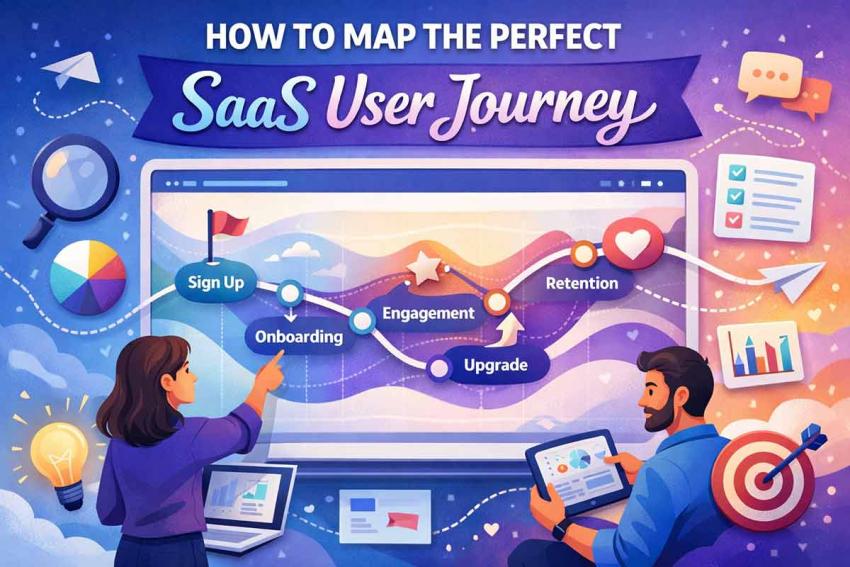
Success depends on how effectively we guide users from the moment they discover our platform to the point where they become loyal advocates. A well-structured SaaS user journey helps reduce churn, improve customer satisfaction, increase conversions, and maximize customer lifetime value.
Mapping the perfect SaaS user journey requires a deep understanding of customer behavior, expectations, motivations, and pain points at every stage. When we align our product, marketing, onboarding, and support systems around the customer experience, we create a scalable growth engine that drives long-term revenue.
What Is a SaaS User Journey?
A SaaS user journey is the complete path a customer takes while interacting with a software platform. It begins with awareness and continues through acquisition, onboarding, engagement, retention, expansion, and advocacy.
Unlike traditional customer journeys, SaaS journeys are continuous. Subscription-based models depend heavily on recurring engagement, making every interaction critical to retention and growth.
The ideal SaaS user journey includes:
- Product discovery
- Website interaction
- Free trial or demo signup
- Onboarding process
- Product adoption
- Feature engagement
- Customer support interactions
- Renewal decisions
- Upsells and referrals
Each stage must work together seamlessly to deliver value quickly and consistently.
Why SaaS User Journey Mapping Matters
Companies that invest in journey mapping gain a significant competitive advantage. Understanding the customer lifecycle enables us to optimize every touchpoint and eliminate friction.
Key Benefits of User Journey Mapping
- Higher conversion rates
- Improved onboarding completion
- Lower churn rates
- Increased customer retention
- Better customer satisfaction
- Enhanced feature adoption
- Higher recurring revenue
When we understand how users behave, we can personalize experiences, automate communication, and proactively solve problems before customers abandon the platform.
The Core Stages of the SaaS User Journey
1. Awareness Stage
The awareness stage is where potential users first discover the SaaS product. This typically happens through:
- Organic search
- Social media
- Paid advertising
- Influencer recommendations
- Online reviews
- Content marketing
- Referrals
At this stage, users are searching for solutions to a problem. Our goal is to position the SaaS platform as the ideal answer.
How to Optimize the Awareness Stage
Create SEO-Focused Content
Publishing high-quality blog posts, guides, case studies, and comparison pages helps attract qualified traffic from search engines.
Important SEO elements include:
- Keyword optimization
- Search intent alignment
- Internal linking
- Structured headings
- Fast-loading pages
- Mobile optimization
Use Educational Content
Potential users respond well to value-driven educational content such as:
- Tutorials
- Industry reports
- Webinars
- SaaS comparison articles
- Problem-solving guides
This builds trust and authority early in the customer journey.
2. Consideration Stage
Once users become aware of the software, they begin evaluating whether it meets their needs. During this phase, users compare features, pricing, integrations, and usability.
Critical Consideration Factors
- Ease of use
- Product scalability
- Security
- Customer support
- Integrations
- Pricing transparency
- Social proof
How to Improve the Consideration Stage
Build High-Converting Landing Pages
Landing pages should clearly communicate:
- Product benefits
- Key features
- Customer success stories
- ROI potential
- Competitive advantages
Strong CTAs and persuasive copywriting significantly improve conversion performance.
Use Social Proof
Trust signals influence decision-making heavily. Include:
- Customer testimonials
- User-generated reviews
- Video case studies
- Client logos
- G2 and Capterra ratings
These elements reduce uncertainty and build credibility.
3. Acquisition Stage
This is the point where users sign up for a free trial, request a demo, or purchase a subscription.
The acquisition stage determines whether users move deeper into the platform or abandon the process entirely.
Best Practices for SaaS Acquisition
Reduce Signup Friction
Simplify registration forms by requesting only essential information. Long forms create drop-offs and reduce conversions.
Use:
- Single sign-on options
- Social login integrations
- Minimal input fields
- Clear progress indicators
Offer Free Trials Strategically
Free trials should provide enough value for users to experience meaningful outcomes quickly.
Effective trial strategies include:
- Product-led onboarding
- Feature highlights
- Guided walkthroughs
- Usage milestones
- Automated onboarding emails
4. Onboarding Stage
Onboarding is one of the most critical phases of the SaaS user journey. A poor onboarding experience leads to low activation rates and high churn.
The goal of onboarding is to help users achieve their first success as quickly as possible.
Key Components of Effective SaaS Onboarding
Interactive Product Tours
Users should understand the platform without needing lengthy documentation.
Interactive onboarding can include:
- Tooltips
- Checklists
- Product walkthroughs
- Guided setup flows
- Contextual education
Personalized User Experiences
Segment users based on:
- Industry
- Company size
- Role
- Goals
- Use cases
Personalization increases engagement and accelerates product adoption.
Time-to-Value Optimization
The faster users experience value, the higher the retention rate.
We should identify the platform’s core “aha moment” and design onboarding around reaching it quickly.
5. Product Adoption Stage
After onboarding, users begin integrating the platform into their daily workflow.
This stage focuses on increasing engagement and feature usage.
How to Improve Product Adoption
Monitor User Behavior
Analytics tools help track:
- Feature usage
- Session duration
- User paths
- Drop-off points
- Engagement trends
Behavioral insights reveal friction points and opportunities for optimization.
Use In-App Messaging
In-app communication encourages feature discovery and continuous engagement.
Examples include:
- Feature announcements
- Upgrade prompts
- Educational tips
- Usage recommendations
Provide Knowledge Resources
A strong self-service support system improves user confidence.
Include:
- Help centers
- Video tutorials
- FAQs
- Community forums
- Documentation libraries
6. Retention Stage
Retention is the foundation of SaaS profitability. Acquiring users is expensive, but retaining customers generates sustainable recurring revenue.
Strategies to Improve SaaS Retention
Deliver Consistent Value
Users stay subscribed when the product continuously solves problems efficiently.
Regular updates, performance improvements, and innovative features keep customers engaged.
Proactive Customer Support
Fast, reliable support reduces frustration and improves loyalty.
Use multiple support channels:
- Live chat
- Email support
- AI chatbots
- Dedicated account managers
- Ticket systems
Track Customer Health Scores
Customer health metrics help identify users at risk of churning.
Monitor:
- Login frequency
- Feature engagement
- Support tickets
- Subscription activity
- NPS scores
This enables proactive intervention before cancellation occurs.
7. Expansion Stage
Existing customers often represent the greatest growth opportunity.
Expansion includes:
- Upselling
- Cross-selling
- Plan upgrades
- Add-on purchases
How to Drive SaaS Expansion Revenue
Identify Power Users
Highly engaged users are more likely to upgrade.
Use behavioral data to trigger personalized upgrade recommendations based on:
- Usage limits
- Team growth
- Feature needs
Demonstrate Additional Value
Expansion offers should align with user goals and workflow improvements.
Avoid aggressive sales tactics. Instead, focus on demonstrating measurable outcomes.
8. Advocacy Stage
Satisfied customers become powerful brand advocates.
Advocates generate:
- Referrals
- Testimonials
- Reviews
- Social shares
- Case studies
How to Turn Customers Into Advocates
Create Referral Programs
Referral incentives encourage customers to promote the platform.
Offer rewards such as:
- Account credits
- Discounts
- Extended features
- Exclusive access
Encourage Reviews
Request reviews after positive milestones, such as:
- Successful onboarding
- Goal completion
- Subscription renewals
Positive reviews strengthen brand authority and increase acquisition efficiency.
How to Build a SaaS User Journey Map
Step 1: Define User Personas
Start by identifying customer segments.
Include:
- Demographics
- Goals
- Pain points
- Technical expertise
- Buying motivations
Detailed personas improve journey accuracy.
Step 2: Identify Customer Touchpoints
Map every interaction users have with the brand.
Examples include:
- Website visits
- Ad clicks
- Email campaigns
- Product onboarding
- Customer support interactions
Every touchpoint affects user perception.
Step 3: Analyze User Behavior
Use analytics platforms to understand how users navigate the product.
Important tools include:
- Google Analytics
- Mixpanel
- Hotjar
- Amplitude
- Heap
Behavioral data uncovers bottlenecks and opportunities.
Step 4: Detect Friction Points
Identify where users struggle or abandon the process.
Common SaaS friction points include:
- Complicated onboarding
- Poor UI/UX
- Slow support
- Confusing pricing
- Feature overload
Eliminating friction improves retention and conversions.
Step 5: Optimize Continuously
User journey mapping is not a one-time process.
Continuously test and improve:
- Landing pages
- User flows
- Onboarding experiences
- Email campaigns
- Product features
Successful SaaS companies constantly refine the customer experience.
Essential Metrics for Measuring SaaS User Journey Success
Tracking the right KPIs ensures continuous optimization.
Important SaaS Metrics
Customer Acquisition Cost (CAC)
Measures how much it costs to acquire a customer.
Customer Lifetime Value (CLV)
Calculates total revenue generated from a customer relationship.
Churn Rate
Tracks the percentage of customers who cancel subscriptions.
Activation Rate
Measures how many users complete key onboarding actions.
Net Promoter Score (NPS)
Indicates customer satisfaction and loyalty.
Monthly Recurring Revenue (MRR)
Tracks predictable subscription revenue growth.
Common SaaS User Journey Mistakes
Avoiding these mistakes improves overall customer experience.
Ignoring Onboarding
Weak onboarding causes users to abandon products before experiencing value.
Overcomplicating User Flows
Complex interfaces create confusion and frustration.
Lack of Personalization
Generic experiences reduce engagement and retention.
Poor Customer Support
Slow or ineffective support damages trust and increases churn.
Failing to Analyze Data
Without analytics, optimization becomes guesswork.
Final Thoughts
The perfect SaaS user journey is built through continuous optimization, customer understanding, and seamless user experiences. Every stage of the journey influences conversions, retention, and long-term revenue growth.
By mapping customer interactions carefully and improving each touchpoint strategically, we create a scalable SaaS growth system that attracts users, delivers value efficiently, and transforms customers into loyal advocates.
A successful SaaS business does not simply sell software. It creates a frictionless experience that helps users achieve meaningful outcomes consistently.