Climate headlines often sound dramatic. Ice sheets collapse. Oceans surge. Coastal cities disappear beneath rising water. The warnings arrive fast and furious, and many people ask the same question: How High Will Sea Level Rise? The answer deserves attention. It also deserves scrutiny.
Science continues evolving. Predictions change. Models improve. Data grows stronger. Some forecasts miss the mark. Others prove surprisingly accurate. When discussing sea level rise, healthy questions matter because understanding risk requires more than accepting alarming headlines at face value.
So let’s cut through the noise. How much will oceans rise? What drives the change? Are the worst possible moments unavoidable, or does reality tell a more nuanced story?
Why Sea Levels Are Rising
To understand How High Will Sea Level Rise, we first need to examine what fuels the change. There are two broad drivers of global sea level rise.
1. Melting Glaciers and Ice Sheets
Greenland and Antarctica store ancient frozen freshwater in massive reservoirs. But as surface temperatures of the Earth rise, glaciers are experiencing recession. Ice sheets lose mass. More water flows into the oceans.
It is more like an ice pot on the stove, where the heat underneath is slowly rising. The process can start slowly and then multiply after a while.
Greenland is a focus for scientists because the ice loss there is responsible for much of that sea-level rise. Antarctica presents another concern. Certain ice regions there show increasing instability, which could accelerate future changes. Ice loss does not happen overnight. But it adds up.
2. Thermal Expansion of Ocean Water
Liquid expands when it warms. The oceans take up more than ninety percent of the heat. Even without melting ice, warmer oceans are denser, which causes some increase in level. That means two directions, and simultaneously, both problems arrive from. Melting land ice adds water. Warmer oceans expand. Together, they create a powerful combination.
So, How High Will Sea Level Rise?
There is no simple answer to the question. The bulk of the future hinges on greenhouse gas emissions, climate policies, and technological change.
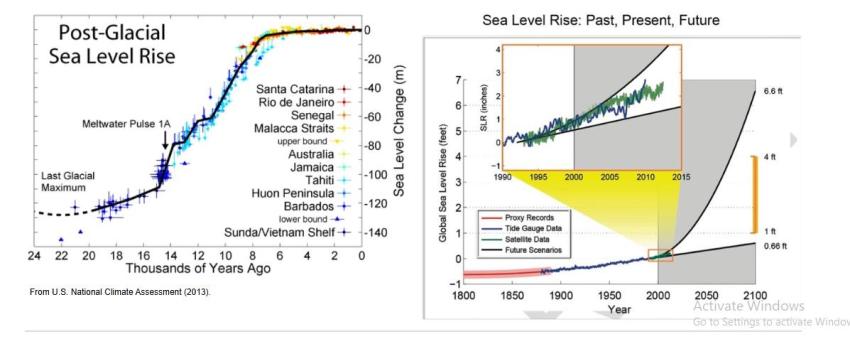
Global average sea levels rise between thirty-two inches and six feet. The increases are generally smaller in low-emission scenarios. Higher-emission pathways have distinctly more risk.
Some predict a scale of 1 to over 3 feet increase in global average sea level rise by the end of this century. Ocean systems respond slowly.
Ice sheets continue evolving. It may have lasting repercussions for centuries to come. This reality makes climate scientists hone their predictions.
Why Small Increases Matter More Than People Think
A few centimeters are not the reason to lose sleep over it. Reality tells a different story. Like, even small jumps amp up coastal floods. Storm surges reach farther inland. High tides create larger impacts. Infrastructure faces greater stress.
For communities already susceptible to flooding, they often end up walking an ever-tighter rope. But now consider a coastal road that floods once in every ten years. That rare occurrence, rising seas, may soon turn into something far more common. It can be said for this case that the place between intentional inconvenience and harmful disruption is as slim as an inch.
Regions Facing Greater Risk of How High Will Sea Level Rise
The impact of rising oceans does not spread evenly. Some regions stand closer to the front lines. Low-lying coastal cities face higher vulnerability. Island nations face unique challenges. River delta regions encounter increasing flood risks. Population density compounds the problem. Large urban centers near coastlines often carry enormous infrastructure investments.
Transportation networks. Water systems. Power infrastructure. Homes. Businesses. Everything sits within the equation. The stakes rise quickly.
Melting Ice Creates Global Consequences
When people ask, How high will sea level rise, they often focus on beaches disappearing. The story reaches much farther. Rising oceans influence freshwater resources. Saltwater intrusion threatens agriculture. Coastal wetlands experience disruption.
Marine ecosystems face changing conditions. Economic impacts follow closely behind environmental changes. Insurance pressures increase. Property risks grow. Infrastructure costs climb.
Communities adapt or pay a steeper price later. Climate impacts rarely travel alone. They arrive carrying luggage.
Solutions That Can Make a Difference for How High Will Sea Level Rise
The situation feels daunting. But solutions exist.
1. Reducing Greenhouse Gas Emissions
Lower pollution reduces future warming. Less warming slows sea level rise in the long term. One of them is the transition to less carbon-intensive energy systems. Energy efficiency improvements help.
Transportation innovation matters. Industrial improvements contribute. Small actions alone will not solve everything. Large-scale action creates momentum.
2. Coastal Protection Measures
Stakeholders are more and more investing in resilience strategies. Examples include:
● Flood barriers
● Improved drainage systems
● Wetland restoration
● Elevated infrastructure planning
● Shoreline protection projects
Adaptation does not eliminate rising oceans. It reduces vulnerability.
3. Better Climate Monitoring
Scientists continue refining sea level projections through satellite technology, ocean monitoring systems, and climate modeling. More precise information improves planning. Better planning improves resilience. Knowledge becomes a valuable tool.
What Individuals Can Learn from Rising Seas
The question How High Will Sea Level Rise extends beyond scientific curiosity. It reveals how interconnected natural systems truly are. An ice sheet melting thousands of miles away can influence coastlines across continents.
Ocean warming affects communities globally. Climate patterns bind the world in ways few can fathom until changes appear at their doorstep.
Looking Ahead to How High Will Sea Level Rise
Still, the central question remains important: How High Will Sea Level Rise? The answer continues evolving as science advances and human choices shape future climate conditions. One reality stands clear. Melting ice and rising oceans no longer represent distant possibilities. They shape today’s world. And tomorrow’s.
Understanding the science gives people something valuable. Perspective. Because when facing global challenges, knowledge often becomes the first line of defense.