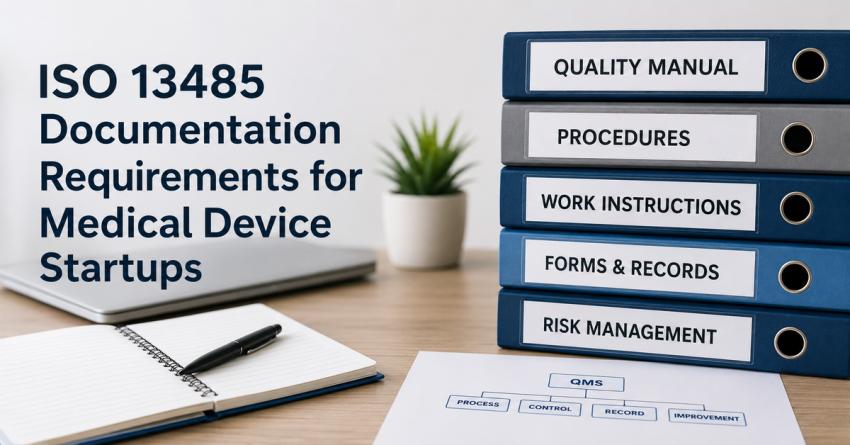
Medical device startups entering regulated markets must establish a structured quality management system (QMS) to ensure product safety, regulatory compliance, and consistent manufacturing processes. One of the most widely accepted standards for this purpose is ISO 13485. Understanding ISO 13485 documents is critical for startups to avoid audit failures, reduce compliance risks, and achieve faster certification readiness.
For early-stage companies, documentation is often the most challenging part of implementation because it requires structured procedures, controlled records, and alignment with regulatory expectations.
Why ISO 13485 Documentation Is Critical for Startups
ISO 13485 is heavily documentation-driven. Regulators and certification bodies do not only evaluate products—they evaluate how processes are defined, controlled, and recorded.
Startups often face issues such as:
• Lack of standardized procedures
• Missing or incomplete records
• Inconsistent process control
• Weak risk management structure
Without proper documentation, even high-quality products may fail certification audits.
Proper ISO 13485 documents help startups:
• Establish repeatable processes
• Demonstrate regulatory compliance
• Reduce audit nonconformities
• Improve product safety and traceability
Core ISO 13485 Documentation Requirements
Startups must prepare a structured set of controlled documents and records to comply with ISO 13485 requirements. These typically include:
1. Quality Manual
The quality manual defines the overall structure of the QMS. It explains how ISO 13485 requirements are implemented within the organization, including process interactions and responsibilities.
2. Document Control Procedure
A document control system ensures that all documents are approved, updated, and accessible only in their current version. This prevents outdated procedures from being used during operations.
3. Risk Management Procedure
Risk management is a core requirement under ISO 13485. Startups must identify potential risks throughout the product lifecycle and implement control measures. This process is closely aligned with ISO 14971 principles.
4. Design and Development Procedures
This includes documentation of product design stages, verification, validation, and design transfer activities. It ensures that medical devices meet both customer and regulatory requirements.
5. Corrective and Preventive Action (CAPA) Procedure
CAPA procedures help identify root causes of nonconformities and implement corrective actions to prevent recurrence. This is a key focus area during audits.
6. Internal Audit Procedure
Startups must conduct internal audits to evaluate QMS effectiveness and identify gaps before external certification audits.
7. Supplier Evaluation Procedure
Since medical devices often rely on external suppliers, ISO 13485 requires evaluation and monitoring of supplier performance to ensure quality consistency.
8. Training and Competency Records
Employees must be trained based on defined competencies, and training records must be maintained as evidence of qualification.
Common Documentation Challenges Faced by Startups
Many startups struggle during ISO 13485 implementation due to:
• Lack of ready-to-use templates
• Difficulty understanding regulatory language
• Incomplete process mapping
• Time constraints during product development
• Limited internal QA expertise
These challenges often delay certification and increase audit risk.
To overcome these issues, startups often rely on structured ISO 13485 documentation kits that provide pre-defined procedures, SOPs, and templates aligned with regulatory expectations. A complete set of ISO 13485 documents helps medical device startups implement ready-to-use procedures and audit-ready templates, improving compliance readiness and reducing certification delays.
Best Practices for Effective ISO 13485 Documentation
To ensure smooth certification, startups should follow these practices:
• Keep documentation simple and process-oriented
• Ensure all procedures are linked to actual operations
• Maintain version control for all documents
• Regularly update risk assessments and CAPA records
• Conduct internal audits before certification audits
A well-structured documentation system not only supports certification but also improves operational efficiency and product quality.
Conclusion
ISO 13485 documentation is a fundamental requirement for medical device startups aiming to enter regulated markets. Properly structured procedures, records, and quality manuals help organizations demonstrate compliance, reduce risks, and prepare effectively for certification audits.
Startups that invest early in standardized ISO 13485 documents systems are better positioned to achieve faster certification and long-term regulatory success.