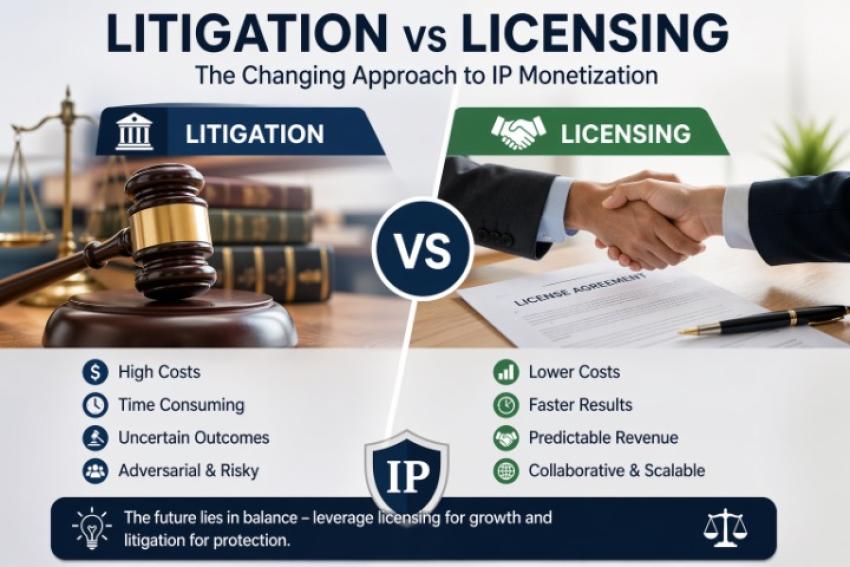
Intellectual property has moved from a defensive legal shield to a strategic business asset. Companies no longer view patents, trademarks, or copyrights as mere protections. They now see them as revenue drivers. This shift has changed how businesses approach monetisation. The traditional reliance on litigation is giving way to a more balanced, often licensing focused strategy.
This article explores how and why this transition is taking place, and what it means for businesses, innovators, and legal professionals.
Understanding IP Monetisation
IP monetisation refers to the process of generating revenue from intellectual property assets. It includes various methods such as licensing, assignment, franchising, and enforcement through litigation.
Earlier, many organisations relied heavily on litigation to extract value. The approach was simple. Enforce rights, stop infringement, and claim damages. While effective in certain cases, litigation often proved costly, time consuming, and uncertain.
Today, businesses are adopting more nuanced strategies. Licensing has emerged as a preferred route in many industries due to its commercial flexibility and lower risk.
The Traditional Dominance of Litigation
Litigation has long been a cornerstone of IP enforcement. Rights holders used courts to protect exclusivity and deter unauthorised use. High profile disputes across technology, pharmaceuticals, and media reinforced its importance.
However, litigation comes with several challenges:
- High legal costs and extended timelines
- Uncertain outcomes due to judicial interpretation
- Potential damage to business relationships
- Public scrutiny and reputational risks
For many companies, especially startups and small enterprises, these barriers make litigation less appealing as a primary monetisation strategy.
The Rise of Licensing as a Strategic Tool
Licensing allows IP owners to grant permission to others to use their intellectual property in exchange for royalties or fees. It offers a collaborative approach rather than an adversarial one.
Several factors have contributed to the rise of licensing:
1. Commercial Efficiency
Licensing creates predictable revenue streams without the need for prolonged disputes. It enables faster market access and scalability.
2. Global Expansion
Through licensing agreements, businesses can enter new markets without heavy investment in infrastructure or operations.
3. Innovation Ecosystems
Industries such as technology and pharmaceuticals rely on shared innovation. Licensing facilitates cross collaboration and accelerates development.
4. Risk Mitigation
Unlike litigation, licensing reduces uncertainty. Parties can negotiate terms, define scope, and avoid costly conflicts.
Changing Industry Trends
The shift from litigation to licensing is evident across multiple sectors.
Technology Sector
Technology companies increasingly rely on patent licensing. Standard essential patents in telecommunications are a prime example. Companies license their patents to multiple players, creating a steady income stream.
Pharmaceutical Industry
Drug companies use licensing to expand distribution and research partnerships. This approach supports faster access to medicines while maintaining profitability.
Entertainment and Media
Copyright licensing has become central to content distribution. Streaming platforms operate on licensing agreements, ensuring creators receive royalties while reaching global audiences.
When Litigation Still Matters
Despite the growing preference for licensing, litigation remains relevant. It plays a critical role in certain situations:
- When infringement is deliberate and damages are substantial
- When negotiations fail or licensing is refused
- When precedent setting judgments are required
- When maintaining exclusivity is crucial for market position
In such cases, litigation acts as a strong enforcement tool and deterrent.
The Hybrid Approach
Modern IP strategies often combine both licensing and litigation. Businesses use licensing as the primary monetisation method while keeping litigation as a backup enforcement mechanism.
This hybrid approach offers several advantages:
- Flexibility in dealing with different market scenarios
- Strong negotiation leverage
- Balanced risk and reward
- Improved long term value of IP assets
Companies are increasingly building internal IP portfolios with monetisation in mind. Legal teams work closely with business units to identify licensing opportunities while preparing for enforcement when necessary.
The Role of Legal Expertise
Effective IP monetisation requires careful planning and expert guidance. Drafting licensing agreements, conducting valuation, and managing disputes demand specialised knowledge.
Engaging experienced professionals can make a significant difference. Businesses often consult trademark law firms in delhi to navigate complex branding and licensing strategies. These firms assist in structuring agreements that maximise commercial value while ensuring legal compliance.
Similarly, a comprehensive approach to IP management may involve working with an IP Law firm in Delhi. Such firms provide integrated services covering patents, trademarks, copyrights, and enforcement strategies. Their expertise helps businesses align legal frameworks with commercial goals.
Key Considerations for Businesses
To adapt to the changing landscape, businesses should focus on the following:
1. Portfolio Assessment
Evaluate existing IP assets and identify monetisation potential. Not all assets require enforcement. Some may yield better returns through licensing.
2. Market Analysis
Understand industry trends and competitor strategies. Licensing opportunities often arise from market demand and technological gaps.
3. Contractual Clarity
Well drafted agreements are essential. Clear terms on usage, royalties, duration, and dispute resolution reduce future conflicts.
4. Enforcement Strategy
Maintain readiness for litigation when necessary. A credible enforcement stance strengthens negotiation power.
5. Long Term Vision
IP monetisation should align with overall business strategy. Short term gains should not compromise long term value.
The Future of IP Monetisation
The shift towards licensing reflects broader changes in the global economy. Collaboration, innovation, and digital transformation are shaping how businesses operate.
As industries become more interconnected, the importance of shared intellectual property will grow. Licensing will continue to play a central role in enabling this ecosystem.
At the same time, litigation will remain a vital safeguard. It ensures rights are respected and provides a mechanism to resolve disputes when cooperation fails.
The future lies in balance. Businesses must adopt flexible strategies, combining legal enforcement with commercial partnerships.
Conclusion
The approach to IP monetisation is evolving. Litigation is no longer the sole path to value extraction. Licensing has emerged as a powerful alternative, offering efficiency, scalability, and collaboration.
For businesses, the key is not choosing one over the other. It is about understanding when to license, when to enforce, and how to integrate both strategies effectively.
A well planned IP strategy can transform intangible assets into significant revenue streams. In a competitive and innovation driven market, this shift is not just a trend. It is a necessity.