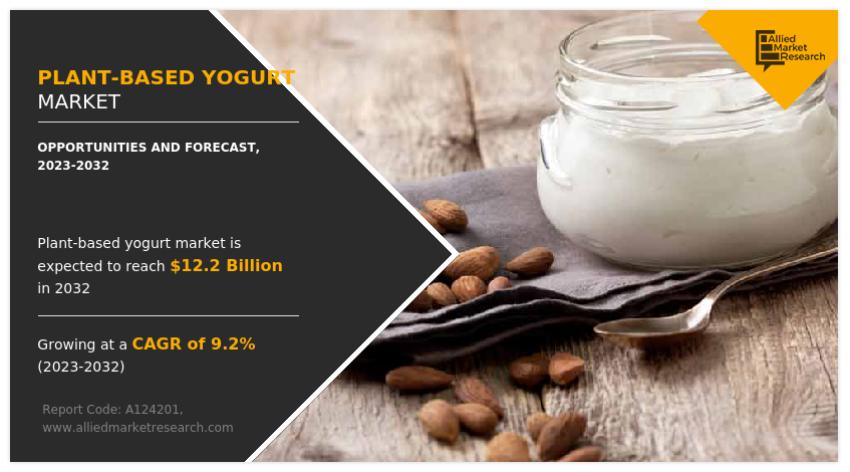
The latest study by Allied Market Research, titled "Plant-Based Yogurt Market Size, Share & Trends Forecast 2022–2032," offers an in-depth analysis of the global and regional dynamics shaping this rapidly evolving industry. This comprehensive report highlights the competitive landscape, key market segments, value chain analysis, and emerging technological and regulatory trends expected between 2022 and 2032. The report provides actionable insights for business leaders, policymakers, investors, and new market entrants seeking to understand growth opportunities and mitigate risks. It explores strategic frameworks that help organizations leverage market opportunities, adapt to disruptions, and build long-term competitive advantages.
➤ Request a Sample Copy of this Report (Complete TOC, Tables & Figures Included): https://www.alliedmarketresearch.com/request-sample/A124201
With a focus on innovation, scalability, and future readiness, this report equips decision-makers with actionable insights, rich visuals, and verified data-driven strategies. As the global vegan and lactose-free food movement accelerates and consumer preferences shift decisively toward sustainable, plant-based alternatives, the Plant-Based Yogurt Market is witnessing transformative growth across raw materials, flavors, distribution channels, and geographies.
➤ Report Overview:
- Market Size Value (US$ Mn): 2022–2032
- Market Value in 2022: USD 5,043.3 Million
- Market Value by 2032: USD 12,200.4 Million
- CAGR & Year-over-Year Growth: 9.2% (2023–2032)
- Historical Data: 2022–2023
- Base Year: 2022
- Forecast Period: 2022–2032
- Report Pages: 290 | Tables: 140 | Charts: 68
➤ Market Drivers of Plant-Based Yogurt Market
The growth of the Plant-Based Yogurt Market is primarily driven by the rise in the global vegan and lactose-intolerant population, increasing investment and innovation by food companies in plant-based formulations, and growing consumer concern related to environmental sustainability. Lactose intolerance affects a significant portion of the global population, directly expanding the addressable market for plant-based dairy alternatives including soy, almond, coconut, and oat-based yogurts. Health-conscious consumers are further attracted by plant-based yogurt's low fat and cholesterol content, probiotic benefits, and allergen-friendly profile. Major food companies are significantly investing in R&D to develop improved flavor, texture, and nutritional profiles leveraging technologies such as enzymatic processing, high-pressure processing (HPP), extrusion, and advanced fermentation techniques. Additionally, the increasing penetration of retail and online distribution channels, the rise in social media-driven consumer awareness, and growing demand for clean-label, vegan-certified products are creating lucrative opportunities and positioning the market for sustained momentum over the forecast period.
➤ Scope of the Plant-Based Yogurt Market:
The Plant-Based Yogurt Market encompasses a fast-evolving ecosystem of plant-based ingredient sourcing, fermentation technology, product manufacturing, and multi-channel retail distribution. The holistic approach tracks the entire value chain from plant milk ingredient suppliers (soy, almond, coconut, oat, rice), fermentation specialists, and food manufacturers to supermarkets, specialty stores, online retailers, and end consumers across core regions including North America, Europe, Asia-Pacific, and LAMEA. The report also examines food safety and labelling regulatory frameworks, ESG and sustainability trends in plant-based agriculture, next-generation formulation innovation pipelines, and investment outlooks, positioning this study as an end-to-end roadmap for stakeholders navigating growth, risk, and transformation in the global plant-based dairy alternatives landscape.
➤ Following are the Players Analyzed in the Report:
- Daiya Foods Inc.
- The Hain Celestial Group, Inc.
- Oatly Group AB
- General Mills Inc.
- Kite Hill
- Califia Farms, LLC
- Springfield Creamery
- Nush Foods
- Danone S.A.
- Forager Project
➤ Comprehensive Segmentation and Classification of the Report:
By Raw Material:
- Soy
- Almond
- Coconut (dominated the market in 2022; driven by health-conscious demand for dairy-free, allergen-friendly, MCT-rich alternatives)
- Others (Oat, Rice, and others)
By Flavor:
- Original/Plain (dominated the market in 2022; popular for versatility in cooking, baking, and direct consumption)
- Vanilla
- Strawberry
- Blueberry
- Others
By Distribution Channel:
- Supermarket/Hypermarket (dominated the market in 2022; expected to maintain dominance and witness the highest growth during the forecast period)
- Convenience Store
- Specialty Store
- Online Store (fast-growing channel driven by e-commerce expansion and social media marketing)
➤ Regional Analysis:
» North America: U.S., Canada, Mexico (Largest market with highest revenue in 2022; driven by surging vegan population, growing health awareness, and strong retail and online channel penetration) » Europe: UK, Germany, France, Italy, Spain, Russia, Rest of Europe (Strong vegan culture, clean-label demand, and well-established plant-based food market) » Asia-Pacific: China, Japan, India, Australia, Rest of Asia-Pacific (Growing rapidly driven by high lactose-intolerance prevalence, rising health consciousness, and urbanization) » LAMEA: Brazil, UAE, South Africa, Saudi Arabia, Rest of LAMEA (Emerging demand for vegan and dairy-free products supported by growing middle-class health awareness)
➤ Highlights of Our Report:
- Extensive Market Analysis: A deep dive into plant-based ingredient capabilities, fermentation technology innovations including HPP, enzymatic hydrolysis, and emulsification and production volumes within the global Plant-Based Yogurt Market.
- Corporate Insights: An in-depth review of company profiles spotlighting major players and their strategic manoeuvres including product launches, R&D investments, mergers, acquisitions, and capacity expansion strategies.
- Consumption Trends: A detailed analysis of consumption patterns across raw materials, flavors, and distribution channels, offering insight into current demand dynamics and evolving vegan and health-conscious consumer preferences.
- Segmentation Details: An exhaustive breakdown of raw material, flavor, and distribution channel segments depicting the market's spread across diverse consumer demographics and retail formats globally.
- Pricing Evaluation: A study of pricing structures and elements including raw material costs, specialized production equipment, and R&D investment premiums influencing plant-based yogurt market pricing strategies.
- Future Outlook: Predictive insights into market trends, growth prospects, and potential challenges including high production costs, inconsistent taste and texture, and intensifying competitive dynamics through 2032.
➤ Key Benefits of the Report:
- Data-driven insights into trends, opportunities, and challenges from 2022 to 2032
- Forecasts of revenue by segment (raw material, flavor, distribution channel) and region
- Competitive landscape benchmarking and market share analysis with player positioning
- Porter's Five Forces analysis highlighting the potency of buyers and suppliers
- Regulatory and innovation trend impact assessments including vegan certification standards, clean-label regulations, and food processing technology advancements
- Strategy frameworks (Porter's Five Forces, SWOT, PESTEL)
- In-depth analysis of emerging growth strategies and disruptions in the global plant-based dairy alternatives industry
➤ For Purchase Enquiry: https://www.alliedmarketresearch.com/purchase-enquiry/A124201
➤ Key Reasons to Buy:
- This report profiles key players in the Plant-Based Yogurt Market based on the following parameters company details (founding date, headquarters, manufacturing bases), product portfolio, sales data, market share, and ranking.
- This market report illustrates key insights about market drivers, restraints, opportunities, market trends, and regional outlook.
- This report provides an in-depth analysis of the Plant-Based Yogurt Market and provides market size (US$ Million) and CAGR for the forecast period (2022–2032), considering 2022 as the base year.
- This report elucidates potential market opportunities across different segments and explains attractive investment proposition matrices for this market.
➤ Table of Contents:
- Chapter 1: Introduction, market driving force, product objective of study and research scope of the Plant-Based Yogurt Market
- Chapter 2: Exclusive Summary the basic information of the Plant-Based Yogurt Market
- Chapter 3: Displaying the Market Dynamics Drivers, Trends, Challenges & Opportunities of the Plant-Based Yogurt Market
- Chapter 4: Presenting the Plant-Based Yogurt Market Factor Analysis, Supply/Value Chain, PESTEL Analysis, Market Entry, Patent/Trademark Analysis
- Chapter 5: Displaying the market by Raw Material, Flavor, Distribution Channel, and Region/Country 2022–2032
- Chapter 6: Evaluating the leading manufacturers of the Plant-Based Yogurt Market Competitive Landscape, Peer Group Analysis, Market Positioning & Company Profiles
- Chapter 7: To evaluate the market by segments, by countries, and by manufacturers/companies with revenue share and sales by key countries in these various regions (2022–2032)
- Chapters 8 & 9: Appendix, Methodology and Data Source
➤ Key Questions Answered:
- Who are the major players operating in the Plant-Based Yogurt Market?
- What is the expected market size and CAGR through 2032?
- Which raw materials, flavors, distribution channels, and geographies will lead growth?
- What are the top challenges and growth inhibitors, including high production costs, inconsistent taste and texture, and limited raw material availability?
- How is the competitive landscape evolving through R&D investments, product innovation, mergers, acquisitions, and retail channel expansion?
- What are the most effective strategies for entry, expansion, and sustainability in the global plant-based yogurt industry?