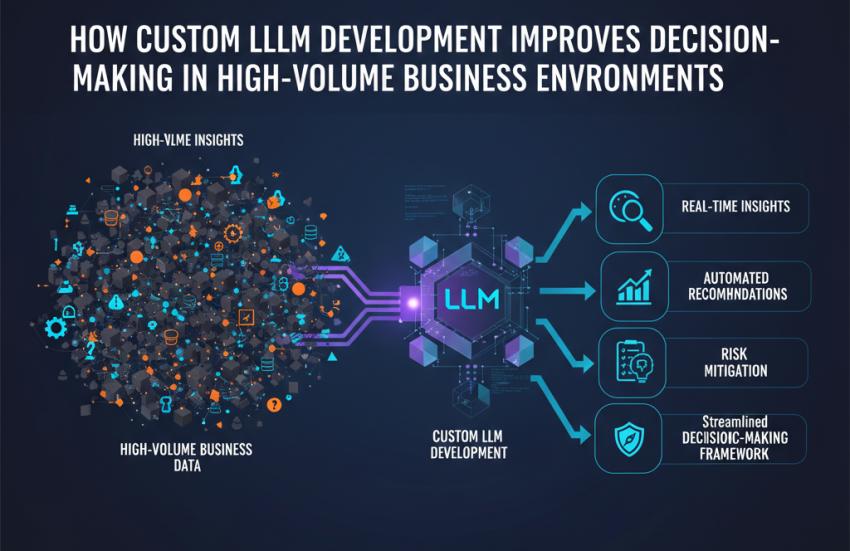
Enterprises today operate in environments where decisions are made continuously and at scale. Customer interactions, supply chain movements, financial transactions, compliance checks, internal communications, and market signals generate volumes of data that exceed human processing capacity. The organizations that succeed are not simply collecting data. They are converting it into operational intelligence that guides action with speed and confidence.
This is where Custom LLM Development has become a strategic priority. Large language models are no longer experimental tools. They are production systems that analyze unstructured information, extract meaning, and support decision processes across departments. For global enterprises and well-funded startups, the focus has shifted from curiosity to measurable business outcomes.
The Decision Bottleneck in High-Volume Operations
High-volume business environments face a common constraint. Information arrives faster than teams can interpret it. Reports are generated daily, customer feedback flows continuously, support tickets pile up, compliance documents expand, and internal knowledge bases grow without consistent structure.
Traditional analytics tools work well with structured data. They struggle with text-heavy sources such as emails, contracts, call transcripts, chat logs, policy documents, and research material. As a result, decision-makers often rely on partial visibility. This creates delays, inconsistent judgments, and missed opportunities.
Language models change this equation. When designed for enterprise-specific workflows, they read, summarize, classify, compare, and reason over large information sets. This allows leadership teams and operational units to act based on comprehensive context rather than fragmented inputs.
Why Generic Models Are Not Enough
Public language models are powerful but they are not designed for proprietary data environments, regulated industries, or specialized workflows. Enterprises require controlled deployment, governance frameworks, and domain-specific knowledge alignment.
This is where Custom LLM Development becomes critical. Instead of relying on general-purpose systems, companies build models trained or adapted to internal data, terminology, policies, and decision criteria. The result is consistency in interpretation and outputs that match business reality.
A dedicated LLM Development Company provides the infrastructure design, data engineering, model optimization, evaluation frameworks, and deployment architecture needed for enterprise-grade systems. This reduces risk while accelerating adoption.
How LLM Development Services Improve Decision Quality
Well-executed LLM Development Services directly influence how decisions are made across high-volume environments.
Operational Intelligence
Language models process incoming text data in real time. Support tickets are categorized, escalations are predicted, recurring issues are summarized, and action items are extracted. Operations teams gain structured insight from previously unstructured streams.
Executive Reporting
Weekly reports, meeting notes, market updates, and performance dashboards can be summarized into decision-ready briefs. Executives receive context-rich digests instead of raw documents. This shortens review cycles and improves clarity.
Risk and Compliance Review
Contracts, regulatory filings, audit logs, and policy documents can be scanned for inconsistencies, missing clauses, or potential compliance gaps. This reduces manual review effort while increasing coverage.
Customer Experience Analysis
Feedback, reviews, surveys, and chat conversations are interpreted for sentiment, topic trends, and churn signals. Leadership gains a direct view into customer experience drivers rather than relying only on numerical scores.
Knowledge Retrieval
Internal documentation becomes accessible through conversational search. Teams locate policies, technical procedures, and historical decisions quickly. This reduces time lost in internal information hunting.
Each of these outcomes translates into faster decisions, reduced labor costs, and stronger consistency across departments.
From Automation to Augmented Judgment
Enterprises often ask whether LLM-Powered Solutions replace human decision-making. In practice, they augment it. Models handle scale, extraction, synthesis, and preliminary reasoning. Humans apply accountability, domain judgment, and final authority.
This collaboration works particularly well in environments where decisions must be frequent but still defensible. Financial approvals, procurement evaluations, HR policy interpretation, underwriting assessments, and enterprise sales qualification all benefit from structured model support with human oversight.
The Role of LLM Consulting Services
Adopting language models without a strategic plan often leads to pilot projects that stall. LLM Consulting Services help enterprises identify high-impact use cases, define data readiness requirements, design governance frameworks, and calculate expected ROI.
Consulting typically covers:
- Use case prioritization
- Data access and privacy strategy
- Model evaluation metrics
- Integration planning
- Change management planning
- Security and compliance alignment
This ensures initiatives move beyond experimentation into scalable production systems.
Integration Into Existing Enterprise Systems
Decision improvement happens only when models connect to existing workflows. LLM Integration Services focus on embedding models into CRM systems, ERP platforms, customer support tools, document management systems, analytics dashboards, and internal knowledge platforms.
Integration ensures that insights arrive where decisions already happen. Employees do not need to learn separate tools. They receive model outputs within familiar interfaces, increasing adoption and minimizing disruption.
Business Impact and ROI
Enterprises investing in custom LLM solutions typically pursue measurable outcomes:
- Reduced manual processing time
- Shorter decision turnaround cycles
- Higher consistency in policy application
- Lower support resolution costs
- Improved customer retention
- Increased employee productivity
According to recent enterprise AI adoption reports, organizations implementing domain-specific language models have reported productivity gains ranging from 20 percent to 40 percent in knowledge-heavy roles. Another study highlights reduced compliance review time by over 50 percent in document-intensive industries.
While results vary by use case maturity, the overall trend is clear. Companies that align model development with operational goals realize compounding efficiency benefits.
Data Governance and Trust
Decision systems must be reliable. Enterprises require auditability, traceability of outputs, bias monitoring, access control, and clear accountability structures. Custom model development allows governance frameworks to be built into the system design rather than added later.
This is especially important for financial services, healthcare, legal operations, public sector systems, and multinational enterprises operating across regulatory jurisdictions.
Selecting the Right Development Partner
Choosing a partner for enterprise-grade model development requires technical depth and business understanding. A capable provider combines data engineering, model training, evaluation pipelines, infrastructure deployment, security practices, and post-launch optimization.
Organizations exploring LLM Development Services often begin with discovery workshops, data audits, and pilot implementations before moving toward full-scale deployment. A structured approach reduces risk and ensures long-term sustainability.
Looking Ahead
High-volume business environments will continue generating more information, not less. Competitive advantage will belong to organizations that convert this information into reliable decisions faster than their peers.
Custom LLM Development is not a technology trend. It is a decision infrastructure investment. Enterprises that build models aligned with their data, governance requirements, and operational workflows gain sustained decision agility.
As model tooling, compute efficiency, and data pipelines mature, adoption barriers will continue to fall. Early movers are already establishing internal language intelligence layers that will become as foundational as analytics platforms and data warehouses.
Final Perspective
Decision-making has always been at the heart of enterprise success. What has changed is the volume, velocity, and complexity of information driving those decisions. Language models provide the missing link between raw unstructured data and actionable intelligence.
Organizations that approach implementation through strong LLM Consulting Services, structured development, and thoughtful integration will achieve consistent decision improvement across departments.
In a business landscape defined by scale and speed, investing in LLM-Powered Solutions is no longer optional for enterprises that aim to operate with confidence, precision, and sustained performance.