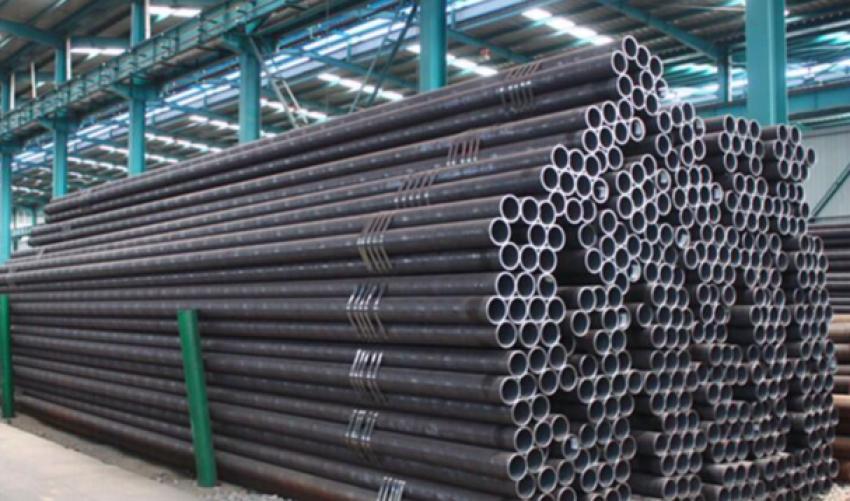
In the steel pipe industry, the core difference between black steel pipes and white steel pipes lies in their surface treatment and corrosion resistance, not in the material itself.
What are black steel pipes?
Black steel pipes do not refer to a special material, but rather to their surface condition and are a basic type of carbon steel pipe without anti-corrosion treatment.
Black refers to the surface color and processing condition of the carbon steel pipe:
Origin of the black color: Because carbon steel pipes do not undergo galvanizing or painting as anti-corrosion treatment after the final manufacturing process, the surface of the pipe is covered with a layer of black iron oxide scale (Fe₃O₄), giving it a dark gray to black appearance, hence the name black steel pipe.
Processing condition: It is the natural state after hot rolling or hot extrusion, belonging to bare pipes.
Advantages and disadvantages of black steel pipes:
Advantages: Carbon steel is inexpensive, has good mechanical strength, and is easy to weld and process.
Disadvantages: Carbon steel black pipe is extremely prone to rust. When exposed to humid air, the oxide scale on the surface breaks down, causing rust to form rapidly.
What is white steel pipes?
White steel pipe refers to black steel pipe that has undergone galvanizing, resulting in a silvery-white zinc coating on the surface (galvanized steel pipe).
Production Process: Galvanized pipe is made by applying a layer of zinc to the surface of black steel pipe through processes such as pickling, hot-dip galvanizing, or electroplating, giving it a silvery-white appearance.
Main Purpose: The zinc layer provides sacrificial anode protection, greatly enhancing the steel pipe's rust resistance in ordinary atmospheric environments.
Cost: Galvanized pipe is more expensive than black steel pipe.
Advantages and disadvantages of galvanized steel pipe:
Best Advantage: Excellent rust resistance. The zinc layer provides "sacrificial anode protection"—even with minor scratches on the coating, zinc will preferentially corrode over iron, protecting the internal steel pipe.
Disadvantages: Higher cost due to the added galvanizing process.
Not suitable for long-term use in strong acids, strong alkalis, or seawater.
When used in drinking water systems, there is a risk of zinc plating peeling and lead residue.
Typical applications of black steel pipes:
Due to their oxide scale and susceptibility to rust, black steel pipes are generally not used directly in environments exposed to the atmosphere or humidity.
Their main uses include:
1. Structural support: Construction scaffolding, factory steel structures, machinery frames, etc. They are usually painted afterwards.
2. Piping systems:
Gas transportation: Indoor distribution pipelines for natural gas and liquefied petroleum gas (must comply with local regulations).
Low-pressure fluid transportation: Such as fire sprinkler systems, some HVAC ducts.
Protective conduit: As sheathing for electrical wires and cables.
3. Machining: Used as raw material for manufacturing other parts.
Typical applications of white steel pipes (galvanized pipes):
Common uses:
Outdoor exposed parts: Building railings, street light poles, outdoor scaffolding.
Water supply pipes: Especially exposed water pipes (now mostly replaced by plastic pipes).
Electrical wiring conduits.
Agricultural greenhouse structure.