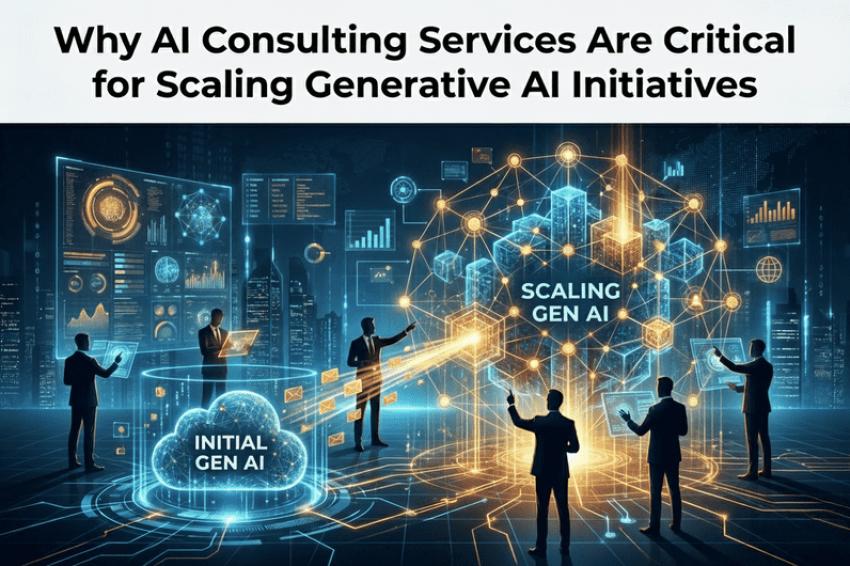
Generative AI has moved beyond experimentation and into the core planning agendas of enterprises and fast-scaling startups. Leadership teams are under pressure to convert early pilots into production-grade systems that create measurable business impact. However, scaling generative AI is not simply a technical expansion. It is an organizational, financial, and governance challenge that requires disciplined execution.
This is where AI Consulting Services become a strategic enabler. Organizations that approach generative AI with structured consulting support are far more likely to move from isolated success stories to enterprise-wide adoption that delivers long-term value.
The reality of scaling generative AI inside large organizations
Initial generative AI use cases often succeed because they are narrow in scope. Teams experiment with content generation, summarization, or internal productivity tools. These pilots typically operate with limited data access, informal governance, and minimal integration requirements.
Once leaders decide to scale, the complexity increases rapidly.
Outputs must be consistent across teams and regions
Data sources need clear ownership and access controls
Infrastructure costs must remain predictable
Compliance and legal teams require transparency and auditability
Industry research from global firms such as Gartner and McKinsey consistently shows that many AI initiatives stall after pilot stages due to missing strategy, fragmented execution, and unclear accountability.
Why internal teams often hit scaling limits
Most enterprise engineering teams are highly capable. However, generative AI introduces challenges that cut across traditional roles and responsibilities.
These challenges include model governance, prompt standards, evaluation frameworks, bias detection, and security design. On top of this, generative systems must align with brand voice, regulatory requirements, and risk tolerance.
Internal teams are usually optimized for delivery and operational stability. They are not always structured to define enterprise-wide AI operating models. This gap is where Custom AI and machine learning consulting services provide significant value by combining strategic planning with execution discipline.
Strategic clarity before technical expansion
One of the most important contributions of consulting is strategic prioritization.
Rather than expanding every possible use case, consultants help leadership teams answer fundamental questions:
Which generative AI initiatives directly support revenue, efficiency, or risk reduction
What success metrics will justify continued investment
Where automation introduces unacceptable operational or reputational risk
By grounding generative AI decisions in business outcomes, organizations avoid spending heavily on initiatives that look impressive but fail to move core metrics.
Governance and compliance as scaling foundations
As generative AI influences customer communication, internal decisions, and knowledge management, governance becomes non-negotiable.
An experienced AI Consulting Company helps enterprises establish clear policies for model usage, data handling, output validation, and escalation paths. These frameworks ensure accountability without slowing innovation.
Regulatory pressure is also increasing. Global frameworks such as the EU AI Act and emerging regional standards demand explainability and risk management. Consulting-led governance models help organizations stay ahead of regulatory changes rather than reacting to them under pressure.
Integration into enterprise systems and workflows
Generative AI creates the most value when it is embedded into existing systems rather than operating as a standalone tool.
This requires careful coordination with data platforms, identity systems, and business applications. Consulting teams work alongside engineering groups to design integrations that are secure, scalable, and maintainable.
This approach aligns naturally with broader AI Development Services, ensuring that generative AI becomes part of the enterprise technology ecosystem instead of an isolated experiment.
Cost management and operational predictability
Scaling generative AI without financial discipline can lead to rapidly escalating costs. Model usage fees, compute requirements, and experimentation cycles can strain budgets if left unchecked.
Consultants bring experience in forecasting usage patterns, defining cost controls, and selecting deployment strategies that balance performance with efficiency. For CFOs and technology leaders, this financial visibility is critical to sustaining long-term investment.
Faster time to measurable value
One of the strongest advantages of consulting support is speed with control.
By applying proven frameworks and lessons learned from previous enterprise deployments, consultants reduce trial-and-error cycles. Teams gain clarity on architecture, governance, and delivery milestones early in the process.
This results in faster transitions from proof of concept to production systems that stakeholders trust and adopt.
Building internal capability, not dependency
High-quality consulting engagements focus on knowledge transfer as much as delivery.
Internal teams receive documentation, operational playbooks, and hands-on exposure to governance and monitoring processes. This enables organizations to evolve their generative AI initiatives independently over time.
For enterprises planning sustained AI investment, this capability building is often as valuable as the initial implementation.
Choosing a consulting partner for long-term scale
Enterprises should evaluate consulting partners based on real-world deployment experience, governance maturity, and alignment with enterprise operating models.
The right partner works collaboratively with leadership, legal, security, and engineering teams. They help organizations design systems that scale responsibly and deliver measurable returns.
Scaling generative AI with confidence
Generative AI has the potential to reshape how enterprises operate, compete, and innovate. However, scaling it without structure increases risk and erodes trust.
With the right consulting approach, organizations gain clarity, control, and confidence. They move beyond experimentation and build generative AI capabilities that are secure, compliant, and aligned with long-term business goals.
For decision-makers, investing in expert guidance is not an overhead. It is a strategic decision that determines whether generative AI becomes a lasting advantage or a stalled initiative.