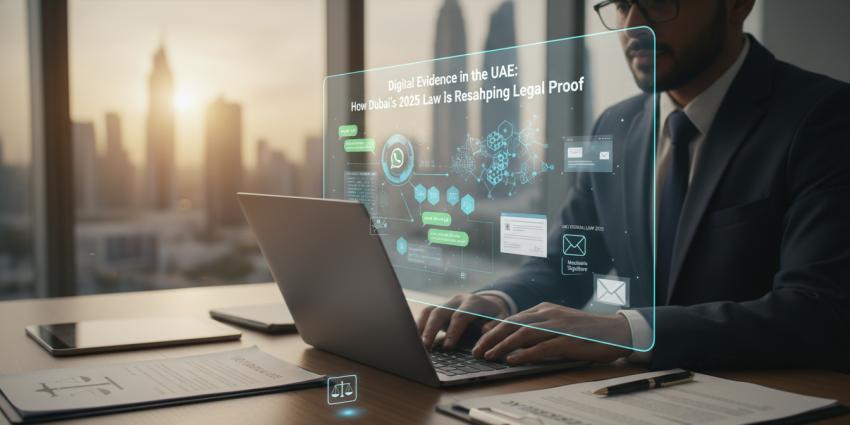
The UAE’s justice system has entered a new era—one where digital communication and blockchain data now carry the same legal weight as traditional documents. With the introduction of Dubai’s 2025 Evidence Law, courts across the Emirates are modernizing how they evaluate digital proof, signaling a major leap toward tech-integrated justice.
Today, everything from WhatsApp messages and emails to blockchain records can serve as valid evidence in both civil and commercial disputes. But with innovation comes responsibility, and understanding how these new laws affect digital admissibility is crucial for individuals and organizations alike.
1. The Evolution of Digital Proof in UAE Courts
In the past, electronic evidence faced skepticism. Courts often questioned its reliability and integrity. However, under the UAE Evidence Law 2025, that has changed.
Now, digitally generated data—including text messages, voice notes, and encrypted ledgers—can be recognized as legitimate proof, provided the source can be authenticated.
This shift is transforming how lawyers prepare cases and how businesses protect their communications. For instance, companies now consult corporate legal advisors in Dubai to implement policies ensuring that emails and digital transactions remain verifiable and admissible in court.
2. What Makes Digital Evidence Acceptable Under the 2025 Law
a. The Role of Authenticity
The cornerstone of admissibility remains authenticity. Courts require proof that a digital file or message hasn’t been tampered with. That means preserving original formats, timestamps, and metadata.
For example, a WhatsApp conversation can be accepted only if accompanied by device verification or an official platform export confirming accuracy. Similarly, a blockchain transaction log must show cryptographic integrity and traceable source ownership.
b. Legal Responsibility and Data Verification
Under Dubai’s new rules, anyone submitting electronic evidence bears responsibility for proving its origin and accuracy. This has encouraged companies to strengthen their compliance mechanisms and rely on expert advocates and legal consultants in Dubai who specialize in digital documentation and e-discovery standards.
3. Common Forms of Digital Evidence Recognized in 2025
The UAE’s updated legislation acknowledges several modern data types as legitimate evidence, marking a turning point in courtroom procedures.
H4: 1. Messaging Platforms and Chat Applications
Instant messaging has become a key source of legal proof. Courts now consider WhatsApp, Telegram, and similar chat logs as admissible, provided authenticity can be verified through timestamps, device analysis, or sender verification. This is especially relevant for employment and commercial contract cases.
H4: 2. Business and Email Communication
Email exchanges form the backbone of many corporate transactions. Under the Dubai Evidence Law 2025, verified email chains—complete with sender authentication—are accepted as reliable documentation of negotiations, approvals, or breaches.
To ensure compliance, companies should work closely with corporate law firms in Dubai offering digital legal solutions to maintain record-keeping standards that align with UAE’s latest judicial requirements.
H4: 3. Blockchain and Encrypted Data
Blockchain’s tamper-proof nature has made it a revolutionary tool for digital evidence. Courts are increasingly admitting blockchain-based records—particularly in real estate, financial, and trade disputes—due to their traceable and verifiable structure.
H4: 4. Multimedia and Cloud-Based Files
Photos, videos, and audio recordings stored in secure cloud environments are also valid under the new regulations, provided that the metadata confirms no post-creation alterations. This change expands the legal scope for digital documentation in criminal, commercial, and civil matters.
4. Ensuring Compliance: How to Prepare Digital Evidence Correctly
While the UAE’s 2025 framework welcomes digital proof, courts expect strict adherence to verification procedures. Here’s how entities can comply effectively:
Preserve Original Files: Never alter or edit the source document or message.
Maintain Metadata: Store timestamps, sender data, and system logs.
Use Forensic Tools: Employ digital forensic experts for device or file verification.
Adopt Secure Systems: Implement blockchain-based or encrypted documentation processes.
Consult Legal Experts: Regularly review compliance with professional legal consultancy firms in Dubai What Makes MAAF Legal Stand Ou to stay aligned with evolving evidentiary standards.
5. Why These Reforms Matter
The recognition of digital evidence demonstrates the UAE’s commitment to modernization, transparency, and fair trial principles. By integrating technology into the judicial system, Dubai is bridging the gap between traditional law and digital reality.
This legal progress not only empowers individuals but also strengthens business confidence—assuring companies that electronic records and communications are now viable tools for defending their rights.
6. The Future of Digital Admissibility in UAE Courts
With technology advancing faster than legislation, Dubai’s judiciary continues to adapt. The next wave of reforms may include AI-assisted document verification and automated authenticity audits to streamline case handling.
Law firms and businesses that proactively adjust to these developments will find themselves better equipped for disputes involving digital evidence in the UAE, ensuring compliance and credibility at every stage.
Conclusion
The Dubai Evidence Law 2025 has redefined how truth is proven in the courtroom. WhatsApp messages, blockchain transactions, and email correspondence are no longer just casual exchanges—they’re legally recognized instruments of proof.
For legal professionals and corporate entities, this means taking proactive steps to secure and authenticate all forms of digital data. Working with experienced legal consultants in Dubai ensures that every piece of evidence meets the highest standards of admissibility—strengthening the foundation of justice in the digital era.