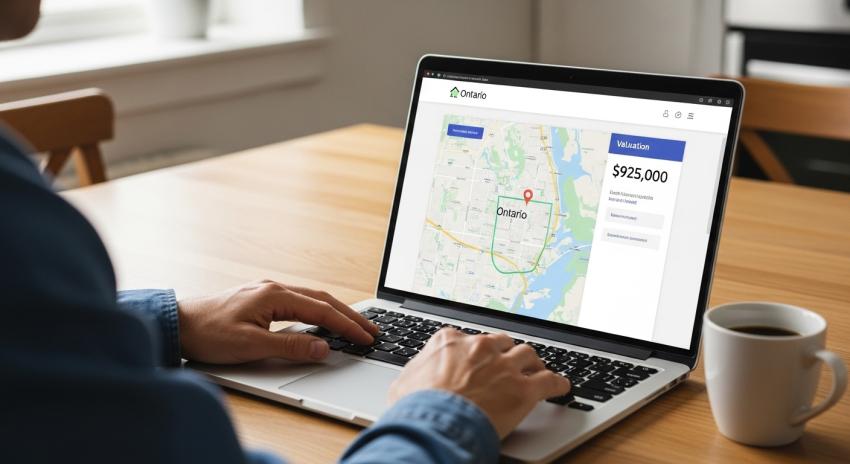
Should You Trust an Online Home Appraisal in Ontario? A No-Nonsense Guide.
Let’s be real. At some point, every single homeowner in Ontario has stared at their house and wondered, “What is this place actually worth today?”
Maybe a neighbour just sold for a wild price, or you’re thinking about your next move, or you’re just trying to figure out your net worth. In the past, answering that question meant bringing in a professional for a formal, time-consuming appraisal. Today, you can get a number spit out from a website in less time than it takes to make a cup of coffee.
But that leads to the real million-dollar question: Can you actually trust that number? Is an algorithm capable of understanding the nuances of your home, your street, and your specific corner of the Ontario real estate market?
If you’re looking for a straight answer, you’ve come to the right place. We’re going to cut through the hype and give you the brutally honest truth about getting an online home appraisal in Ontario—what they get right, what they get wrong, and how to use them like a pro.
First, How Does This Digital Crystal Ball Actually Work?
An online home appraisal, known in the industry as an Automated Valuation Model (AVM), isn't magic. It’s a powerful data-crunching machine. It doesn’t have an opinion and it has never stepped foot in your neighbourhood. It just consumes vast amounts of information to produce a logical estimate.
Here’s a look at its diet:
Public Records: The AVM pulls the official data on your home from sources like the land registry office and the Municipal Property Assessment Corporation (MPAC). This includes your last sale price, your property tax assessment, square footage, and the year it was built.
The MLS® Database: This is the most critical ingredient. The tool scans every recent sale in your area, looking for "comparables"—homes that are similar to yours in size, style, age, and location. The more good comps it finds, the smarter it gets.
Current Market Conditions: It also looks at what’s currently for sale. Are homes in your area selling in a week with multiple offers, or are they sitting on the market for months? The AVM factors in this local market temperature to adjust its valuation.
It blends all this data together to calculate a probable market value. It's pure math, no emotion.
The Real Question: How Accurate is an Online Home Appraisal in Ontario?
This is where the conversation gets real. The accuracy of an online estimate is completely dependent on how much good, clean data it can find for your specific home.
Let’s break it down by how much you can trust the number it gives you:
You Can Probably Bet on It If… You live in a newer subdivision. Think of the sprawling communities in places like Brampton, Markham, or the suburbs of Ottawa. If your house is a 4-bedroom, 3-bathroom model from a major builder and it’s surrounded by hundreds of similar homes, the AVM is in its element. With tons of recent sales of nearly identical houses, the data is clean, consistent, and reliable. The online estimate in these areas is often shockingly accurate.
It’s a Solid Ballpark Figure If… You live in an older, more established neighbourhood where the houses have more variety. Think of the charming, tree-lined streets in cities like Guelph, Kingston, or parts of Toronto. Your century-old brick two-story is different from the 1950s bungalow next door. The AVM can still give you a very useful estimate, but it has a wider margin for error. It can't see your beautifully renovated kitchen or your neighbour's leaky roof. It’s a fantastic starting point, but not the final word.
Take It with a Huge Grain of Salt If… You own a unique property. This applies to custom-built modern homes, sprawling rural properties on several acres, historic homes with tons of quirks, or any house in an area where things rarely go up for sale. In these cases, the AVM is essentially guessing. It has no good "comps" to work with, so its estimate is based on statistical modeling rather than direct evidence. You simply cannot rely on this number to make a major financial decision.
The single biggest weakness of any online home appraisal in Ontario is that it cannot see inside your home. It doesn't know about your high-end finishes, your professionally landscaped backyard, or your dated, wood-paneled basement.
When to Use It vs. When to Call a Human
An online tool is a fantastic resource, but it's not the right solution for every situation. Knowing the difference is key.
An online appraisal is the PERFECT tool when:
You're in the "Just Curious" Phase: It’s the best way to satisfy your curiosity without having to engage a real estate agent.
You're Doing Early-Stage Financial Planning: Want to get a rough idea of your net worth or how much equity you have? It’s perfect for that.
You're Gearing Up to Sell: Use it to get a baseline understanding of your home's value before you start interviewing agents. It helps you go into those conversations with more knowledge.
You're Questioning Your Property Taxes: If your MPAC assessment seems out of whack, a report from a reputable online tool can be a good piece of supporting data.
You absolutely NEED a professional, in-person appraisal when:
You're Finalizing a Mortgage or Refinance: Your lender will require a formal appraisal from a licensed professional they trust. Your online printout won’t cut it.
You're Dealing with Legal Matters: For divorce settlements, estate planning, or capital gains calculations, you need a certified appraisal that will hold up in a legal context.
You're Pricing a Unique Home: If your home falls into that "grain of salt" category, you need a human expert who can properly value its unique features.
The Final Takeaway
So, should you trust an online home appraisal in Ontario? Yes, as long as you understand what it is: a powerful, data-driven estimate. It’s not a legally binding valuation, and it's not a substitute for professional human expertise in high-stakes situations.
Think of it as the Kelley Blue Book for your house. It’s the essential first step to get your bearings, understand the market, and make smarter, more informed decisions. Use it to arm yourself with knowledge, and you’ll be in a much stronger position for whatever you plan to do next.