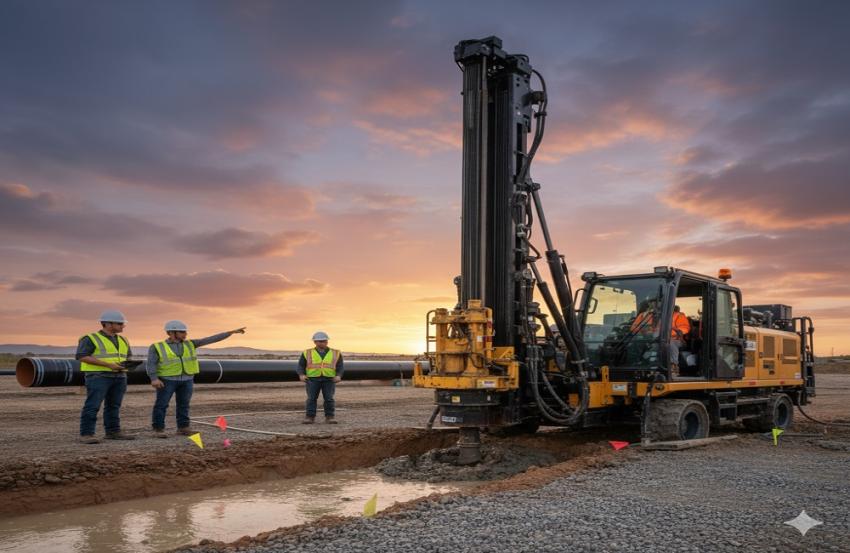
The trenchless technologies have brought horizontal construction a long way with less invasive and efficient ways of installing underground utilities. HDD directional boring is one of the most popular methods today, which is admired for its accuracy, affordability, and also its low level of disturbance. It could be water pipelines, fibre optic cables or gas lines, but to make it come out smoothly, proper planning and implementation are critical. These are professional suggestions that may be used to guarantee success in any size HDD project.
1. Conduct a Thorough Site Investigation
The first step before any boring is done is to know the conditions of what is under the surface. The professional site investigation must cover:
Testing on the soil to ascertain whether it is clay, silt, sand or rock.
- Geotechnical examination to determine possible risks such as underground holes or zones that are liable to cave in.
- Mapping to prevent hitting the current infrastructure like water mains, electrical lines and sewer systems.
The success or failure of a project may depend on the quality of your ground data. Poor evaluation of the same may lead to preventable delays or accidents that are life-threatening.
2. Select the Right Drill Path
Technical drill path planning also leads to accuracy and prevents unneeded complications. Consider:
- The most secure and shortest bore path.
- Proper entrance and exit doors.
- Less sharp bends that may strain the pipe should be avoided.
- Adherence to environmental protection.
The use of software modelling tools can enable the engineers to visualise the bore path and identify possible conflicts before commencing the work.
3. Choose the Appropriate Equipment
It is important to match equipment with the project requirements. For example:
- The drill rigs are different in size and strength. In cities, use smaller rigs, and in the long-distance installations, use larger rigs.
- The bore length and the base conditions must match the drill rods.
- Drill heads and cutters ought to be chosen depending on how hard the soil or rock is.
The high quality of equipment employed, in good condition, involves reducing the number of breakdowns and makes everything run smoothly.
4. Use High-Quality Drilling Fluid
The drilling fluid is important for the stability of the bore. It:
- Lubricates the drill head.
- Maintains bore pressure.
- Carries to the surface and makes cuttings.
The formula of the right drilling fluid should be designed based on the composition of the soil. The improper handling of the fluids may result in the collapse of the borehole or in a phenomenon known as a frac-out, in which case, the fluid is released into the nearby vicinity.
5. Prioritise Safety and Compliance
Directional boring is also not entirely safe as compared to open trenching, but still, it is still not entirely safe. Follow best practices:
- Train operators thoroughly.
- Compliance with regulatory provisions.
- Inspect all machinery daily.
- Undertake safety briefings at every shift.
A good safety culture helps in safeguarding the employees and the environment.
6. Work with Experienced Professionals
HDD projects require accuracy, design and technical professionalism. Collaborating with the established trenchless companies that are also aware of the directional drilling methods can be quite beneficial to the project results. The experienced operators can navigate the most intricate ground conditions and provide precise installations within time.
Effective HDD projects do not merely rely on equipment but on a plan. Through proper planning, site assessment and professional implementation, proper underground installation can be done with minimal disturbance to the environment and little downtime on the project.
Should you have the next trenchless project on the queue, these tips will put you on the right course, as suggested by experts and will guarantee you long-term results.