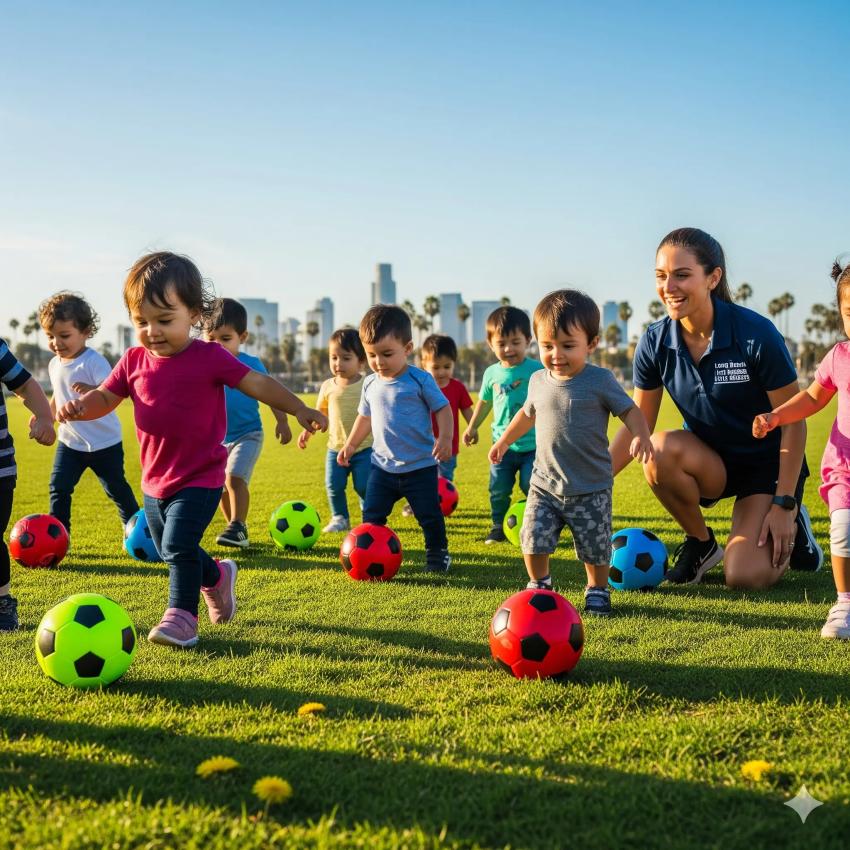
I’ll never forget my son’s first “soccer class.” He was three. The coach, a saint with endless patience, set up a colorful obstacle course at a park over by El Dorado. The goal was simple: get the kids to dribble a ball through some cones.
What actually happened was pure, unadulterated chaos. One kid sat down and started picking dandelions. Another decided the ball was a great thing to sit on. My own child, bless his heart, picked up the ball and ran with it, touchdown-style, in the complete opposite direction. Ten toddlers swarming a single ball like bees on a honeycomb.
I remember catching the eye of another mom, and we just burst out laughing. In that moment, I realized my goal wasn't to find a future superstar. It was to find a place that understood and embraced the beautiful chaos of being a little kid.
If you’re starting to look into a children’s soccer program for ages 2 to 10 years old here in the Long Beach area, that’s the first and most important thing to know. You’re not just signing them up for a sport; you’re looking for the right vibe for your kid and your family.
What Am I Even Paying For? The Difference Between a 3-Year-Old and a 9-Year-Old
When you first start searching, everything blurs together. But what your three-year-old needs is wildly different from what your nine-year-old is ready for.
For the little ones—the 2, 3, and 4-year-olds—forget everything you know about actual soccer. You are essentially paying for a guided playdate. And that’s a great thing! At this age, a win isn't a goal. A win is your kid running around for 45 minutes, learning to not bump into other kids (mostly), and maybe, just maybe, kicking the ball in the general direction the coach is pointing. You want games, imagination, and a coach who is basically a human cartoon character. It's about getting the wiggles out and learning that being active with other kids is fun.
Once they hit 5, 6, or 7, something clicks. They can actually follow a two-step instruction. This is where the first hints of real soccer training begin to appear, but it has to be wrapped in a thick layer of fun. They’re learning to dribble, but it’s a game of "Don't Let the Shark (the coach) Get Your Fish (the ball)!" They’re learning to work together, but it’s still mostly about the joy of chasing the ball with their friends.
Then you get to the 8, 9, and 10-year-olds. Now we’re talking. They get it. They understand teamwork, they can handle more structured drills, and they start to feel the thrill of a real, competitive game. But even here, the vibe is everything. It should still be about improvement and effort, not a coach yelling about a missed shot. This is the age where a love for the game can truly blossom or be extinguished forever by too much pressure.
My No-Nonsense Parent Checklist (What Actually Matters on the Field)
After trying a couple of different programs, I developed my own internal checklist. It has nothing to do with fancy uniforms or how professional the website looks.
The Coach is Everything. Let me be blunt: the coach is the single most important factor. I will take a slightly disorganized league with an amazing, positive coach over a fancy, high-priced program with a grumpy one any day of the week. Watch a class. Is the coach connecting with the kids? Do they know every child's name? Is their energy encouraging and fun? Trust your gut on this.
The "Fun" to "Standing Around" Ratio. Go watch a session. Are the kids constantly moving and engaged, or are they standing in a long line waiting for their one turn to kick the ball? For young kids, engagement is everything. Long lines are the enemy of fun.
The Parent Vibe. Are the other parents on the sideline relaxed and encouraging, or are they screaming at their five-year-old like it's the World Cup final? The culture of the program matters, and the other parents are a big part of that. You’ll be spending a lot of Saturdays with these people.
Location, Location, Location. This is pure logistics, but it's crucial. We live in a car-centric world. A program in Signal Hill is great, but if you live in Belmont Shore and have to fight rush hour traffic to get there, the stress might outweigh the benefit. Be realistic about what you're willing to commit to.
Beyond the Game: What They’re Really Learning Out There
Sure, the goal is to learn some soccer skills. But the real magic is in the stuff they don’t even realize they’re learning. It’s in the shared joy of a goofy goal. It’s in learning to get back up after tripping. It’s in giving a teammate a high-five, even after a loss.
This is the foundation of all kids' athletics. It's resilience. It's teamwork. It's learning that if you practice something, you get better at it. In a world full of screens and instant gratification, a soccer field is one of the few places where effort has a direct and visible result.
So, as you start your search, remember that first day with my touchdown-scoring son. The goal isn't to find the most intense training or the most competitive league. The goal is to find your kid's happy place. Find the program where they can run, laugh, and kick a ball around in the sunshine. The rest will take care of itself.