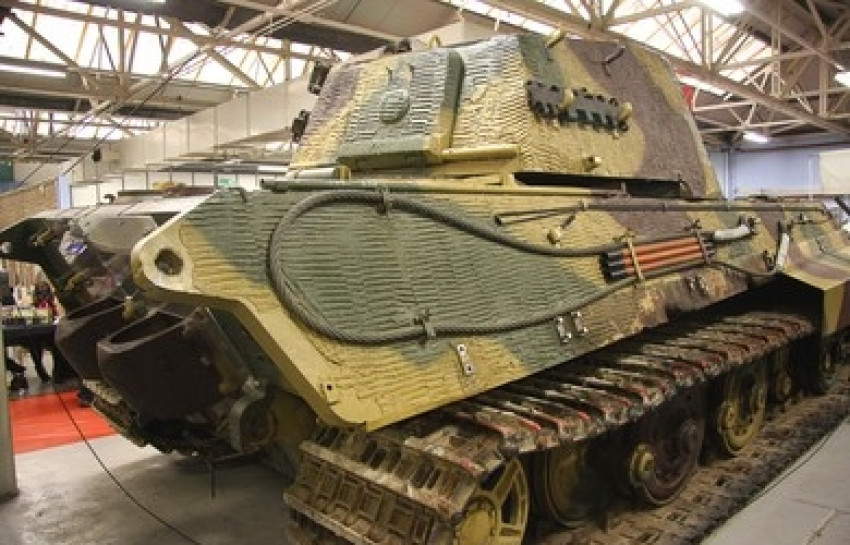
The King Tiger tank, also known as the Tiger II or Königstiger, was one of the most feared and powerful tanks of World War II. Developed by Germany in 1943, this tank was a further improvement upon the already formidable Tiger I tank, with increased armor thickness and improved firepower. In this article, we will take a closer look at the history and design of the King Tiger Tank and its impact on the course of the war.
Design and Development
The King Tiger was designed as a response to the Soviet Union's new heavy tanks, which were proving to be a significant challenge for the German army on the Eastern Front. The tank was designed by the German company Henschel & Son and was first introduced to the battlefield in 1944.
The tank was massive, weighing in at over 68 tons, and was powered by a V-12 Maybach HL 230 P30 engine that could produce up to 700 horsepower. The tank's armor was 180mm thick at the front, making it almost impervious to most anti-tank weapons of the time.
One of the most significant improvements of the King Tiger over its predecessor, the Tiger I, was its armament. The King Tiger was equipped with a long-barreled 8.8cm KwK 43 L/71 gun, which was one of the most powerful tank guns of the war. This gun could penetrate almost any armor at ranges of up to 2,000 meters, making the King Tiger a formidable opponent on the battlefield.
Combat History
The King Tiger saw action on both the Eastern and Western fronts of World War II. It was first deployed in July 1944 during the Battle of Normandy, where it was used to counter the Allied armored offensive. The tank proved to be very effective in this role, as its thick armor and powerful gun made short work of the Allied tanks.
However, the King Tiger's success was short-lived, as the Allied air superiority and the lack of spare parts for the tank proved to be significant challenges. The tank was also very expensive to produce, and only a small number of them were built during the war.
On the Eastern Front, the King Tiger was used primarily to counter the Soviet Union's heavy tanks, such as the IS-2. The tank's thick armor and powerful gun proved to be very effective against the Soviet tanks, and it played a significant role in the battles of the Eastern Front.
Legacy
Despite its limited combat success, the King Tiger tank remains one of the most iconic tanks of World War II. Its massive size, thick armor, and powerful gun made it an intimidating opponent on the battlefield, and it was a symbol of German engineering and technology during the war.
After the war, several countries, including France and the United Kingdom, acquired King Tigers for testing purposes. The tank also inspired the development of several post-war tanks, including the American M103 and the British Conqueror.
Today, several King Tiger tanks can be found on display in museums around the world, including the Musée des Blindés in France and the Tank Museum in the United Kingdom. These tanks serve as a reminder of the power and influence of German engineering during World War II.
Conclusion
The King Tiger tank was a masterpiece of German engineering, designed to counter the Soviet Union's heavy tanks on the Eastern Front. Although it had limited success on the battlefield, the tank remains an iconic symbol of German technology during World War II. Its massive size, thick armor, and powerful gun made it a formidable opponent on the battlefield, and it inspired the development of several post-war tanks. Today, the King Tiger remains a popular subject for military historians and tank enthusiasts alike, and it serves as a reminder of the power and influence of technology during times of war.